Normal Aging vs. Dementia: How to Tell the Difference
Forgetting where you put your keys, struggling to remember someone’s name or walking into a room and forgetting why. These moments happen to just about everyone. But as we get older, they can raise an important question: Are these signs of normal aging, or could it be something more?
Knowing the difference between normal aging and dementia can help you recognize what’s typical, what deserves medical attention and when you or your loved one may benefit from additional care.
The biggest difference is how changes in memory and thinking affect a person’s ability to manage familiar activities and daily tasks. Occasional forgetfulness is a common part of aging. Dementia involves more significant changes in memory, thinking or behavior that interfere with independence and living a fulfilling life.
Not every memory concern points to dementia. Learning what to watch for can make the uncertainty a little easier to navigate.
What Memory Changes Are Normal With Aging?
Normal age-related memory changes include occasionally forgetting names, misplacing items or taking longer to recall information without significantly affecting daily independence. As we age, our brains change along with the rest of our bodies. It may take longer to learn something new, recall a name or remember where we placed an item. These experiences are often referred to as age-related memory loss or age-associated memory impairment.
According to the National Institute on Aging, mild forgetfulness can be a normal part of growing older.
Common examples of normal age-related memory loss include:
- Occasionally forgetting a name but remembering it later
- Misplacing keys or glasses and retracing your steps to find them
- Forgetting an appointment but remembering it with a reminder
- Taking longer to learn a new skill or use unfamiliar technology
- Losing your train of thought during a conversation
- Making an occasional mistake when paying a bill
These experiences can be frustrating, but they generally do not prevent someone from managing their usual responsibilities.
For example, forgetting where you parked your car is different from becoming disoriented in a familiar parking lot and not knowing how to find your way home.
That distinction becomes particularly important when comparing normal forgetfulness vs. Alzheimer’s disease or another form of dementia.
Normal Aging vs. Mild Cognitive Impairment vs. Dementia
Memory loss symptoms don’t always fit neatly into one of two categories.
Mild cognitive impairment (MCI) describes noticeable changes in memory or thinking that go beyond typical age-related forgetfulness but are not severe enough to substantially interfere with living independently.
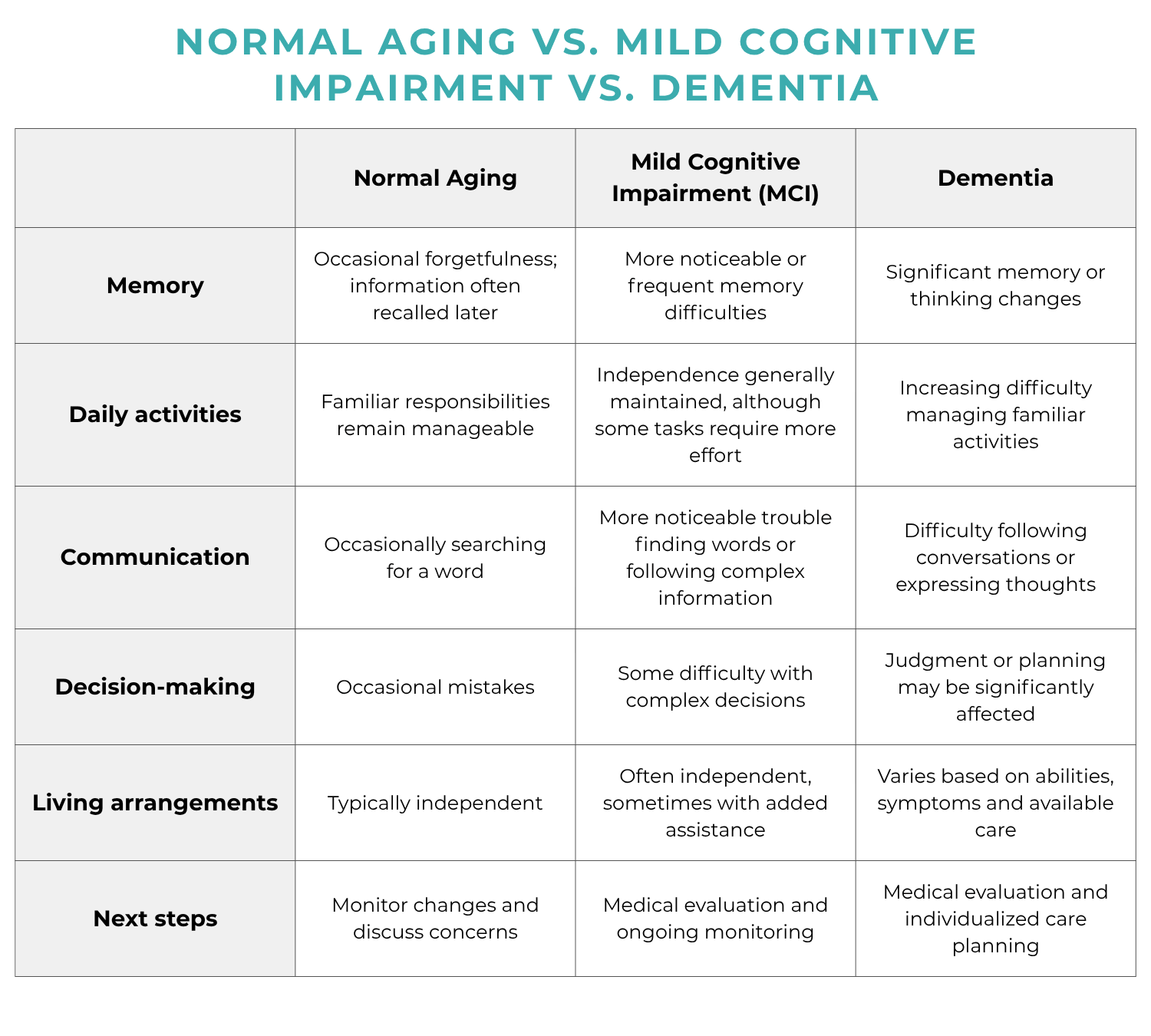
These are general differences, not diagnostic criteria. Symptoms can overlap, and a qualified health care professional should evaluate concerning cognitive changes.
Understanding how MCI differs from dementia is important because MCI does not always progress to dementia. The National Institute on Aging’s guide to mild cognitive impairment explains that people with MCI can generally continue caring for themselves and carrying out familiar activities.
Early Signs of Dementia: When to Worry About Memory Loss
Memory difficulties are often among the first concerns families notice, but dementia can also affect communication, judgment, orientation and behavior.
Changes worth discussing with a clinician include:
- Frequently repeating questions. Forgetting a recent conversation and asking about it several times.
- Getting lost in familiar places. Becoming confused while driving a familiar route or walking through a well-known neighborhood.
- Difficulty completing familiar tasks. Struggling to follow a recipe, manage household finances or complete activities that were previously routine.
- Confusion about time or place. Losing track of dates, seasons or surroundings.
- Changes in judgment. Making unusual financial decisions or having difficulty recognizing potentially unsafe situations.
- Communication difficulties. Frequently losing the thread of a conversation or struggling to express familiar ideas.
- Changes in mood or behavior. Becoming unusually withdrawn, anxious, suspicious or frustrated.
The Alzheimer’s Association’s 10 Early Signs and Symptoms provides additional examples of changes that may warrant attention.
One symptom does not automatically mean someone has dementia. However, persistent or worsening difficulties deserve a conversation with a health care professional, particularly when family members or friends are noticing differences.
Memory Loss Does Not Always Mean Dementia
Memory difficulties aren’t always caused by Alzheimer’s disease or another form of dementia. Certain medical conditions, medications and lifestyle factors can affect thinking and concentration, and some of these causes are treatable.
The National Institute on Aging identifies several conditions that can cause memory problems unrelated to dementia. Potential contributors include:
- Medication side effects or interactions
- Vitamin B12 deficiency
- Thyroid disorders
- Depression or anxiety
- Sleep difficulties
- Dehydration or poor nutrition
- Infections or other medical illnesses
- Hearing or vision difficulties
Sudden confusion deserves particular attention. A rapid change in awareness, attention or behavior may indicate delirium or another urgent medical problem rather than the gradual cognitive decline often associated with dementia. Seek prompt medical evaluation if confusion develops suddenly.
Identifying the underlying cause is an important step toward determining what treatment or assistance may be useful.
When Should You Talk to a Doctor About Memory Concerns?
If you or someone you love is experiencing persistent or worsening changes in memory or thinking, a primary care provider is a good place to begin.
A memory evaluation may include reviewing medical history, medications and symptoms, along with cognitive assessments or other testing. In some cases, a referral to a neurologist or memory specialist may be recommended.
Before the appointment, write down specific examples of what has changed. Include when symptoms began, how frequently they occur and whether they are affecting familiar activities.
Questions worth asking include:
- Are these changes consistent with normal aging, MCI or another condition?
- Could medications or other health concerns be contributing?
- What tests would help clarify the cause?
- Should we consult a memory specialist?
- What should our family watch for between appointments?
- When should we schedule a follow-up evaluation?
A medical evaluation can identify possible causes and provide a starting point for treatment, monitoring or further testing.
How Memory Changes May Influence Living Arrangements
Understanding normal aging vs. dementia can also help families think about what type of living environment or assistance may be appropriate.
A diagnosis alone should not determine where someone lives. Personal preferences, independence, health, social connections and available care-giving resources all deserve consideration.
Normal Aging: Maintaining Independence
Someone experiencing typical age-related forgetfulness can generally continue living independently.
Calendars, written reminders, medication organizers and familiar routines may make occasional memory lapses easier to manage.
For older adults interested in simplifying household responsibilities or enjoying more opportunities for connection, Independent Living may offer an appealing lifestyle.
Mild Cognitive Impairment: Planning for the Future
People with MCI often continue living independently, sometimes with assistance managing appointments, transportation or more complex responsibilities.
This can be a valuable time for families to discuss preferences, explore available resources and plan ahead without making unnecessary changes.
EverTrue Anywhere Care offers services designed to assist older adults wherever they call home. These services are available in the Greater St. Louis area and portions of Illinois.
Dementia: Finding an Appropriate Level of Care
Someone living with dementia may initially remain at home with assistance from family members or professional caregivers.
As the condition progresses, some people require more frequent supervision, assistance with personal care or an environment designed specifically for cognitive changes.
Depending on the individual’s needs, options may include in-home services, Assisted Living or specialized Memory Support.
At EverTrue, the StillYou® philosophy recognizes each person’s abilities, interests, individuality and life story. Memory Support communities build on that approach through specialized dementia care, familiar routines and opportunities for meaningful engagement.
The most appropriate arrangement depends on the person, not simply the diagnosis.
READ: What Is Memory Care Assisted Living and When is it Needed?
Recognizing When Additional Care May Be Needed
As memory or thinking difficulties progress, families may notice that the current living arrangement no longer provides everything their loved one needs.
Signs that it may be time to reassess include:
- Frequent medication mistakes
- Getting lost or wandering
- Difficulty with cooking, bathing or personal care
- Recurring falls or household hazards
- A growing need for supervision
- Confusion or behavioral changes that cause distress
- Family caregivers having difficulty meeting increasing responsibilities
These concerns don’t necessarily require a move. In-home services, adult day programs or respite care may provide the assistance needed to remain at home.
For eligible individuals living with dementia, EverTrue GUIDE provides dementia care navigation, individualized planning and caregiver resources through the Medicare GUIDE Model. Available in the Greater St. Louis area and Springfield, Illinois, the program is designed in part to help people remain in their homes and communities longer when appropriate.
READ: When a Person With Dementia Refuses Care: A Guide for Families
Questions to Ask When Exploring Memory Support
If your family is exploring Memory Support, ask questions that go beyond services and amenities to understand how residents are cared for as individuals:
- How are residents’ abilities, interests and preferences incorporated into their care?
- What training do team members receive in dementia care?
- How are routines adapted as someone’s needs change?
- What happens when a resident becomes confused or distressed?
- How are families involved and kept informed?
- What safety features and supervision are available?
- How does the community help new residents feel comfortable?
These conversations can offer a clearer picture of the environment and whether it reflects the experience you want for yourself or your loved one.
Frequently Asked Questions About Normal Aging vs. Dementia
Is forgetfulness a normal part of aging?
Yes. Occasionally misplacing items, forgetting names or needing more time to recall information can be typical with age. Difficulties that become frequent or interfere with daily responsibilities deserve medical attention.
What is the difference between memory loss and dementia?
Memory loss is a symptom with many possible causes, including aging, medication effects, sleep problems and medical conditions. Dementia describes cognitive decline significant enough to interfere with everyday functioning. Memory loss is common in dementia, but it is not the only symptom.
Does mild cognitive impairment always lead to dementia?
No. Some people with MCI eventually develop dementia, while others remain stable or improve. Medical evaluation and ongoing monitoring can identify changes and possible contributing conditions.
Can someone have dementia and still live independently?
Yes. Some people with early-stage dementia continue living at home, sometimes with assistance. The decision depends on their individual circumstances, including safety, abilities and available care-giving resources.
Understanding Changes and Planning Ahead
Noticing differences in memory or thinking can be unsettling, whether you’re experiencing them yourself or seeing them in someone you love.
The distinction between normal aging, mild cognitive impairment and dementia isn’t always obvious. That’s why paying attention to patterns, asking questions and seeking medical guidance when concerns arise are so important.
A clearer understanding of what’s happening can help you and your family make thoughtful decisions about health, independence and the future, without making assumptions before you have the answers.
Explore Memory Support at EverTrue.